


TL;DR: Judge sideboard storage by usable compartment dimensions, door openings and specified load limits, then check that the loaded cabinet can be accessed in your Lagos dining room.
Key takeaways
- A sideboard's outside width does not tell you the usable space inside each cupboard or drawer; request an internal dimensioned drawing.
- Measure your largest serving dishes, stacked plates and tallest glassware before deciding how the cabinet should be divided.
- Adjustable storage is model-specific: BDI's Ripple 7629, for example, has repositionable drawers and adjustable shelves, not a fixed interior shared by every sideboard.
- Check the manufacturer's installation instructions and shelf limits before loading the cabinet, rather than judging capacity from appearance.
Why is outside width a poor storage test?
Outside width describes the cabinet's footprint, not whether your belongings fit through its doors and onto its shelves. Our buying recommendation is to separate three questions: will the cabinet fit the room, will the objects fit the cabinet, and can you retrieve them comfortably?
A broad frontage can contain several narrow compartments. A large internal space may still have an awkward opening. Drawers, dividers and hardware need to appear on the specification you approve, rather than becoming a surprise on delivery day.
For a Lagos dining room, start with what needs to move out of the kitchen or existing cupboard. If the real problem is storing large serving dishes, buying more small drawers is not much of a solution, however handsome their handles.
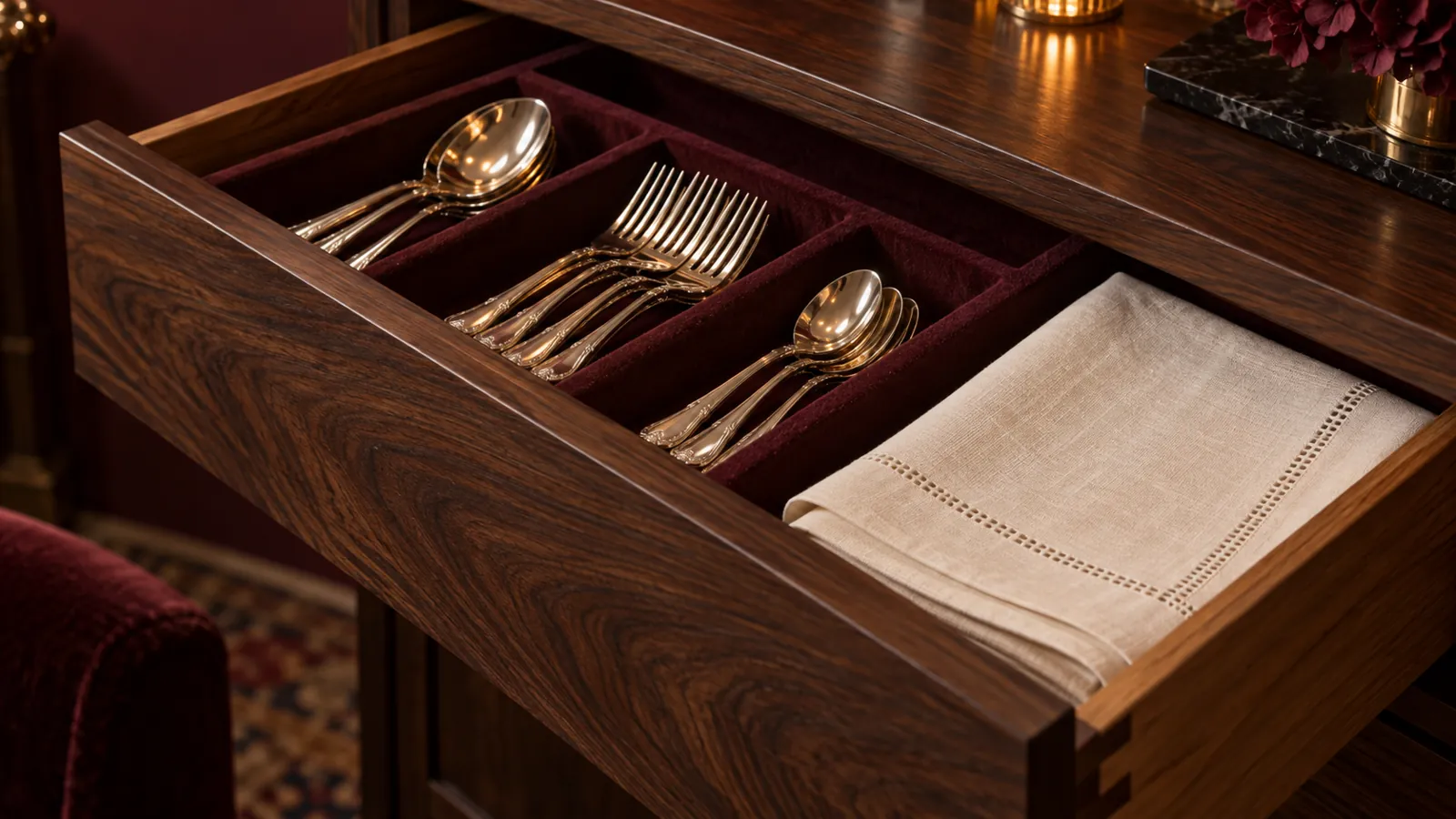
Use the FCI Nigeria sideboard collection as a shortlist, then ask for the interior drawing of each serious candidate. A product photograph is a useful introduction. It is not a capacity certificate.
What should you measure before choosing compartments?
Measure the items that are hardest to store, not just the easiest ones to photograph. Our suggested inventory starts with the widest platter, deepest serving dish, tallest jug and the plate stack you actually use.
Record how each item needs to be stored. A platter standing upright needs a different compartment from one lying flat. A set of glasses needs space to be picked up without knocking the pieces around it. Ask to test the intended arrangement with representative items or accurately sized templates.
For each group, record:
- The item's dimensions, including handles, lids and feet.
- Its normal orientation in storage.
- Whether items are stacked or kept separate.
- How often you need to reach it.
- The proposed compartment and any unresolved fit question.
This is a practical inventory, not a reason to put every household object in the dining room. Our preference is to reserve the most accessible storage for what belongs in that room and gets used there.
Are adjustable shelves and drawers worth requesting?
They are worth considering when the contents vary, but the exact adjustment range matters more than the label. BDI's Ripple 7629 product page describes adjustable glass shelves and storage drawers that can be positioned at the top or bottom of the cabinet.
That is a specific example of a flexible interior, not a claim that FCI stocks the model or that all sideboards share its construction. Use it to sharpen the questions you ask about the cabinet you are buying.

Can a shelf be moved enough to accommodate the tall item on your list? Can a drawer be removed or repositioned? Does changing one compartment make another unusable? Ask the supplier to show the final arrangement on the drawing.
Our judgement is that a slightly smaller cabinet with the right internal layout can be a better purchase than a larger cabinet divided in the wrong places. More frontage does not automatically mean more useful storage.
How should you check shelf and drawer loads?
Get the stated limits for the exact model and configuration, and do not infer them from the material's appearance. The BDI product specification separates interior information and capacities, illustrating why a proper specification matters.
Ask about the top, each shelf and each drawer separately, including how any stated load must be distributed. If the seller cannot provide that information, do not substitute a reassuring guess based on whether the cabinet feels heavy.
For a bespoke unit, put the intended contents into the brief before the interior is finalised. Ask the maker to confirm that the proposed shelves, supports and fittings are appropriate for those contents. A design drawing and a load statement answer different questions; obtain both.
Avoid using a sideboard as a seat or standing platform unless the manufacturer expressly designed it for that use. Storage furniture is not automatically seating furniture.
Can you open it when the dining room is occupied?
Check access with chairs pulled out and people using the room, not only with everything pushed neatly into place. Our recommendation is to mark both the cabinet's closed footprint and the space required by its open doors or drawers.
For a Lagos apartment where the dining area shares a route with the kitchen or sitting room, test the most demanding ordinary moment: someone seated at the table while another person retrieves a dish. Do not assume an open-plan room has unlimited circulation space.

The Lagos dining table size guide can help you review the wider furniture arrangement. For this purchase, the key question is whether the storage remains usable after the table and chairs are in place.
Test handles near walls, doors beside skirting and drawers beside projecting chair backs. A cabinet that opens only when another piece of furniture is moved has brought its own small administrative department.
What belongs in the installation and delivery brief?
Include the actual room location, access route, assembly requirements and manufacturer-specified anchoring. Do not treat those matters as optional extras to settle after choosing the finish.
The BDI Mesa and Ripple instruction manual strongly recommends wall anchoring for those cabinets and calls for appropriate wall fixings. That is model-specific manufacturer guidance, not a statement of Nigerian law or a fixing instruction for a different sideboard.
Have the installer assess the actual wall and follow the chosen cabinet's instructions. Confirm any property permissions before work. Ask the supplier what arrives assembled, what can legitimately be removed for delivery and who completes installation.
For an order coordinated from outside Nigeria, have the person receiving it photograph the interior configuration as well as the exterior. Our suggested acceptance check is simple: the agreed compartments, hardware and installation should be confirmed before the cabinet is loaded.
What should you ask FCI Nigeria to confirm?
Ask for a written cabinet brief that connects your inventory to the proposed interior. Send your largest-item measurements, room plan, access photographs, finish preferences and intended use to FCI Nigeria.
Request the exact exterior and interior dimensions, door and drawer clearances, adjustment options, load limits and installation requirements. Keep availability, delivery scope and any project-specific terms in the written quotation rather than assuming them from this guide.

Limitations
This is a purchasing checklist, not a structural assessment, installation manual or promise that a particular cabinet can carry a particular load. The BDI example illustrates questions to ask; its features and instructions do not transfer to another product. No stock, price or delivery commitment is established here.
Generated images are illustrative storage and planning scenes, not FCI products, premises or completed customer orders.
Get in touch
Want to get in touch? We'd love to hear from you. Email us at [email protected]
Sign Up for Newsletter